The next phase of GeoMIP simulations (named Phase 7 to keep phase with the Coupled Model Intercomparison Project Phase 7) is underway. The experiments were defined starting at the 14th GeoMIP meeting and were finalized after the 16th GeoMIP meeting; the final protocols are described in Visioni et al. (2026).
Our experiments G6-1.5K-SAI, described in Visioni et al. (2024), and intended to be performed by CMIP6 and CMIP7 models alike, has been designated as a Fast Track experiment. If you have questions about the experiment and would like to participate, contact Dan.
Together with G6-1.5K-SAI, modeling groups are running two equivalent experiments for high-latitude, low altitude SAI experiments (G6-1.5K-HiLLA) and for mid-latitudinal MCB (G6-1.5K-MCB).
The GeoMIP contribution to CMIP7 is now published: the new experimental protocols, together with preliminary results, are described in Visioni et al. (2026), and the Tier 1 experiments are summarized in the figure below. For these experiments, which we strongly encourage the community to help analyze, especially in light of the IPCC Seventh Assessment Report (AR7), a large amount of output is openly available on AWS and accessible (with example notebooks) from the Reflective Cloud Hub. Downscaled daily 0.25° SAI climate projections are also available from CarbonPlan (Zarakas et al., 2026).
Modeling groups without interactive stratospheric aerosol schemes can also run the SAI experiments with prescribed stratospheric aerosols. Data availability, implementation, and alignment with the CMIP7 aerosol optical properties are being coordinated in an open GitHub discussion on prescribed aerosols in GeoMIP CMIP7; if your group is planning to use prescribed aerosols, please join the discussion there.
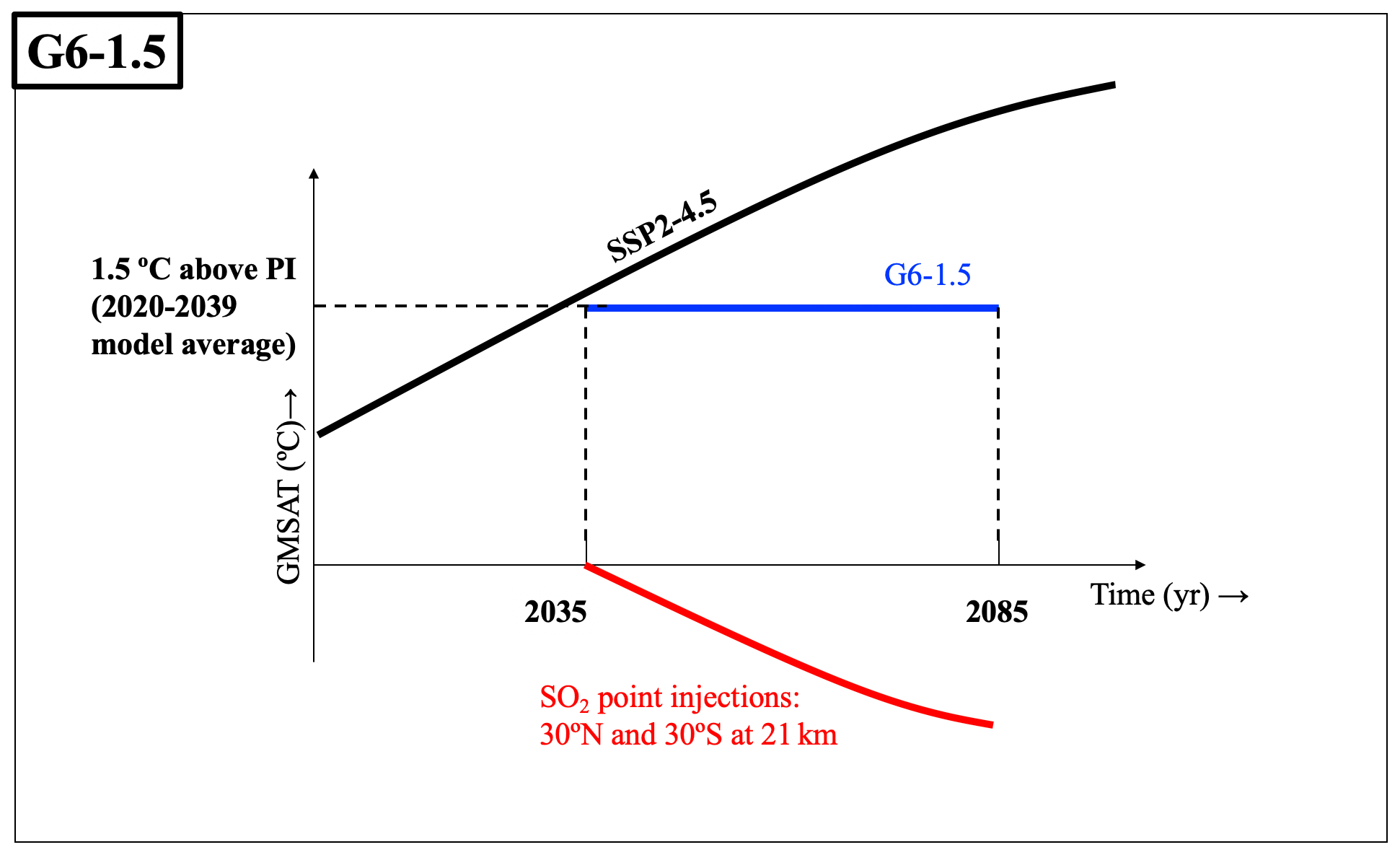 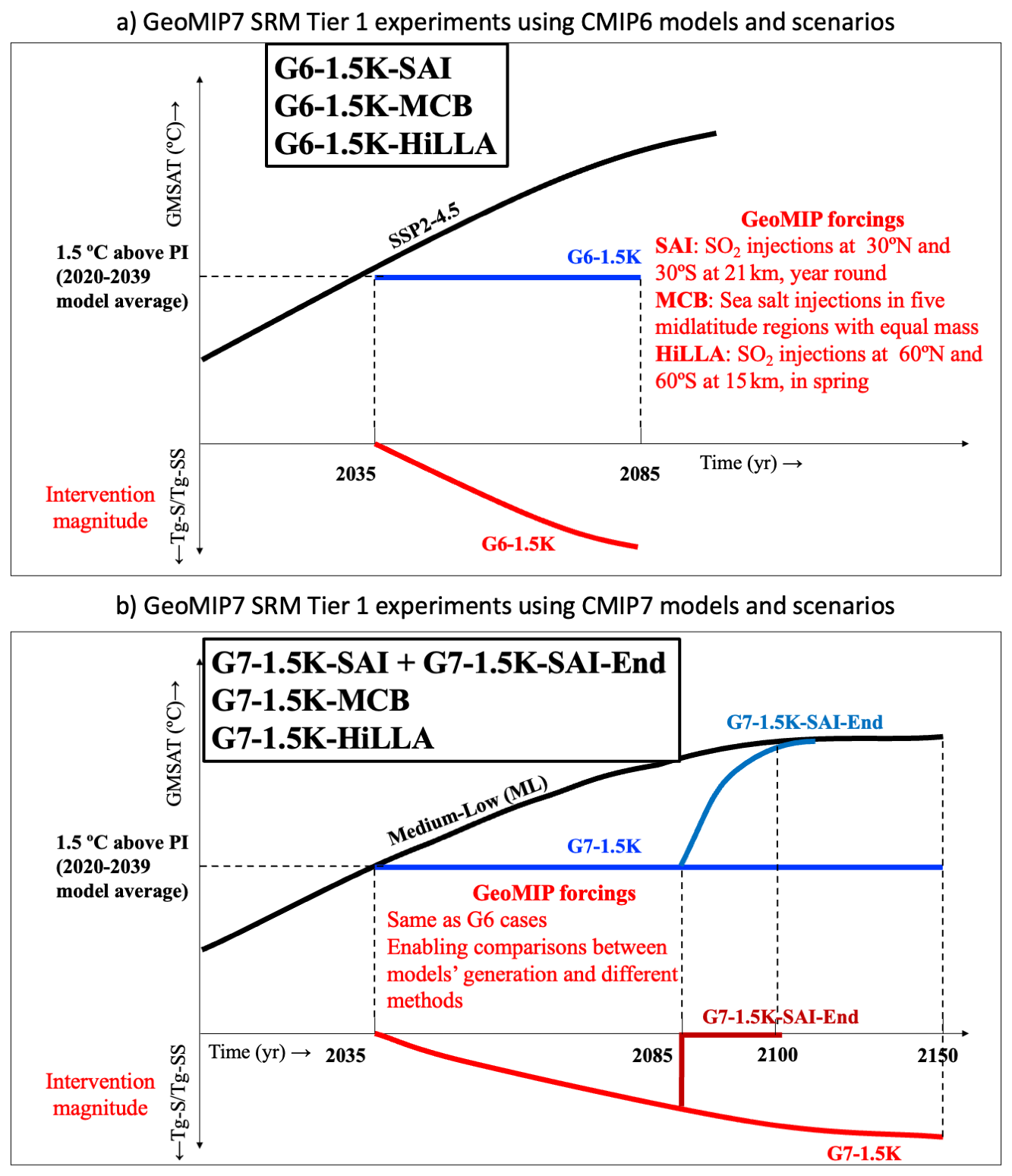
| |
Official GeoMIP policy for data use is that if you use output from a particular model within a certain time window (1 year after publication of the first paper), you must contact the modeling group and offer them a chance to contribute as authors. Each modeling group is well posed to understand its model and the intricacies of performing the GeoMIP experiments, so their perspectives will undoubtedly be useful. The modeling groups can be found on the Participants page.